
Certificate of Need Programs for Home Health and Hospice
Certificate of Need (CON) laws, which vary by state, can affect whether home health and hospice providers enter—or expand within—local markets. In many states, CON approval is tied to state licensure and/or operational authority, which may be a prerequisite for Medicare and Medicaid participation. As a result, CON policies can affect beneficiary access, provider supply, and the timing and location of new or expanded services, including in rural and underserved areas. Separately, CMS relies on federal enrollment and oversight tools to protect Medicare and Medicaid program integrity. Recognizing CON as an upstream, state-based review process can help clarify how state and federal layers interact.
What Is a Certificate of Need?
A Certificate of Need (CON) program is a state regulatory mechanism that requires healthcare providers to obtain approval before opening a new facility, expanding existing operations, or offering certain services. It can include review and approval of significant capital investments and projects involving specific healthcare facilities, outlined by the state. This process helps ensure services align with community needs while meeting applicable quality and regulatory standards.
In CON states, providers must obtain state approval before beginning or expanding services. Because approval is typically tied to state licensure, and state licensure is generally a prerequisite for Medicare and Medicaid participation, the CON process often functions as a front-end gatekeeper for participation in federal programs.
Background
Existing variation in state CON policies reflects a federal framework that Congress established in the 1970s and repealed in the 1980s. CON as a concept primarily originated in Section 1122 of the Social Security Act—added through the Social Security Amendments of 1972[1]—to discourage federal subsidization of unnecessary capital investment, followed by the National Health Planning and Resources Development Act of 1974,[2] which established a nationwide health planning framework. Under Section 1122, Medicare, Medicaid, and Maternal and Child Health programs would not reimburse depreciation, interest, or return on equity capital for capital expenditures exceeding $100,000 that had not been approved by the designated state planning agency. State participation in Section 1122 review was voluntary, and by April 1978, the vast majority of states had a Section 1122 agreement with the Department of Health, Education and Welfare (HEW) or a state CON program.[3]
In January 1975, the President signed the National Health Planning and Resources Development Act of 1974[4] which established a more formal, nationwide health planning framework. Final national planning guidelines were issued on March 28, 1978.[5] Congress repealed the federal health planning mandate effective January 1, 1987,[6] and over the following years, more than a dozen states retired their CON programs.
Since then, decisions about whether to maintain, narrow, or eliminate CON have been made at the state level. Today, CON requirements vary significantly across states—both as to which services are covered and how the review process is structured. Some states apply CON to home health agencies and/or hospice providers, while others have narrowed or eliminated CON entirely.
In parallel, both the Centers for Medicare & Medicaid Services (CMS) and the states use a range of program integrity tools that operate primarily through provider enrollment and ongoing oversight. Some examples include screening and revalidation requirements, site visits, and—in certain circumstances—temporary moratoria on new enrollments in specific provider categories or geographic areas when there is a significant potential for fraud, waste, or abuse. These differing approaches mean that, depending on the state, provider growth may be shaped by a front-end, state planning and approval process, and/or federal pre-enrollment and post-enrollment controls.
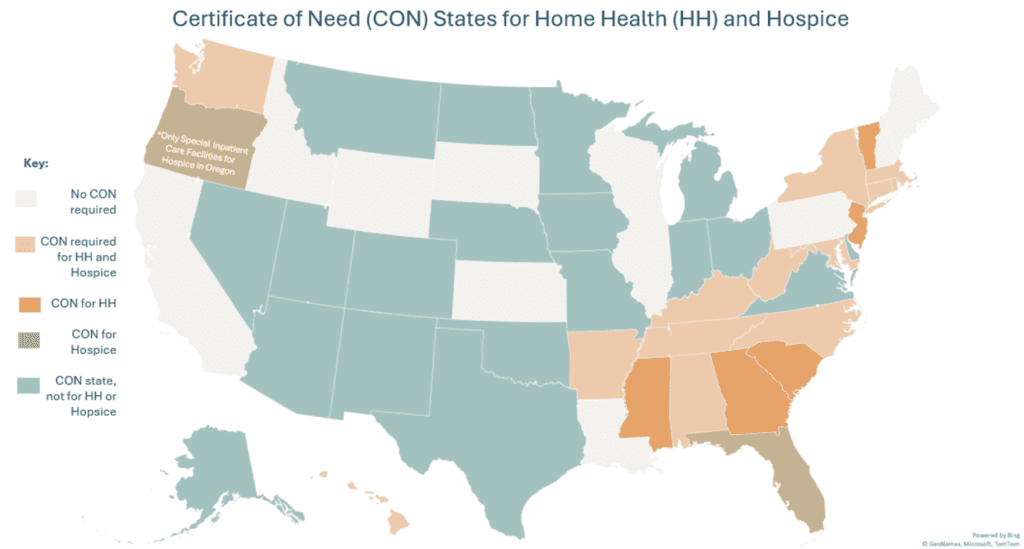
Map last updated on May 7, 2026
Appendix
Appendix
State statue for CON Requirements for Home Health and Hospice.
* Yes, for a Hospice Inpatient Unit, referred to by Oregon statute as “Special Inpatient Care Facilities” (SICF)
Footnotes
[1] Social Security Amendments of 1972, Pub. L. No. 92-603, § 221
[2] National Health Planning and Resources Development Act of 1974, Pub. L. No. 93-641
[3] U.S. Gov’t Accountability Office, HRD-77-157, Status of the Implementation of the National Health Planning and Resources Development Act of 1974 (Nov. 2, 1978), https://www.gao.gov/assets/hrd-77-157.pdf
[4] National Health Planning and Resources Development Act of 1974, Pub. L. No. 93-641
[5] Id. at 13–14 (National Council appointed Aug. 1, 1977; first meeting held Sept. 23–24, 1977; national guidelines not issued until March 28, 1978). The Council was established by Section 1503 of the Act.
[6] Omnibus Budget Reconciliation Act of 1986, Pub. L. No. 99-660, repealing federal health planning provisions effective Jan. 1, 1987.